
A Guide to Invoice Processing
TL:DR
Invoice processing is not simply about capturing invoices. It sits within a wider accounts payable process that controls how and when money leaves the business. When supplier management, purchasing approvals and order controls are properly structured, invoice processing becomes faster, more accurate and far easier to manage.
Inside the guide we cover:
- how approval workflows should be designed
- why supplier purchasing controls matter
- how to prevent duplicate invoices and duplicate payments
- the role of purchase order matching
- how invoice workflows integrate with finance systems
An Author's Note:
At Zahara, we see invoice processing as much more than a finance admin task. Every invoice tells a story about a supplier, a purchase decision and the controls that were in place before the money left the business. This guide is our practical view of how organisations can move from chasing invoices after the fact to building a clearer, more controlled accounts payable process.
Introduction
Most organisations misunderstand invoice processing. It's often treated as an administrative task carried out by the finance team — capturing invoice data and sending it to the accounting system. In reality, invoice processing is one of the most important financial control processes in any organisation.
Every invoice represents a purchasing decision that has already taken place. If the upstream processes around supplier management, purchasing approvals and order controls are weak, finance teams are forced into a reactive role — reviewing invoices after the money has effectively already been committed.
This is why effective accounts payable operations focus on process design rather than simply processing invoices faster.
The Real Role of Invoice Processing
In a well-run finance operation, invoice processing sits within a structured control framework that ensures spending decisions are authorised before invoices arrive.
When the process is working properly, the finance team should already know:
- which supplier was selected
- who approved the purchase
- what goods or services were ordered
- what value was authorised
This is why purchase orders remain such an important part of financial control. When invoices can be matched against an approved order, the approval process becomes significantly simpler and faster.
Why Manual Invoice Processes Break Down
Many organisations still rely on email-based processes for managing invoices. While this may work at small scale, these processes quickly become difficult to control as invoice volumes increase.
Finance teams frequently encounter problems such as:
- invoices sitting in inboxes waiting for approval
- unclear ownership of purchasing decisions
- limited visibility of outstanding liabilities
- duplicate invoices being processed accidentally
These issues are rarely caused by the invoice itself. They are symptoms of a process that has evolved organically rather than being deliberately designed.
How Modern Invoice Processing Works
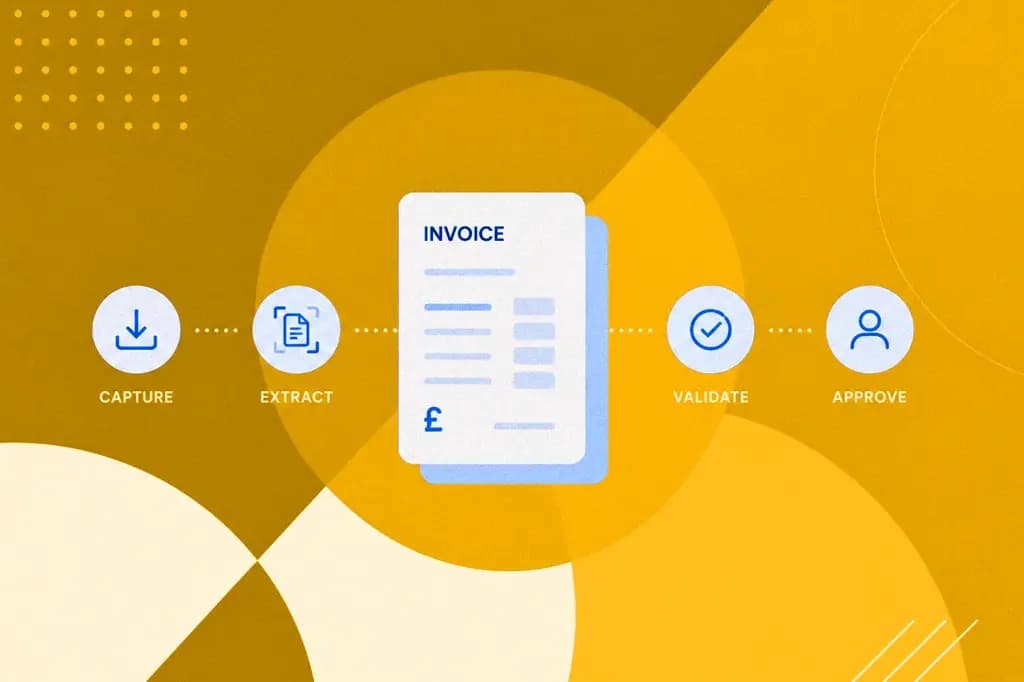
Modern AP systems replace fragmented processes with a structured workflow that captures invoices centrally, extracts key data automatically and routes invoices through defined approval rules.
In a typical automated workflow:
- Invoices are received in a central inbox
- Invoice data is captured automatically
- The invoice is validated against supplier and order records
- Approval workflows route the invoice to the correct approvers
- Approved invoices are posted to the finance system
The result is not simply faster invoice processing. Organisations gain stronger financial control, improved visibility of liabilities and far less risk of incorrect payments.
What This Guide Covers
Beyond the core concepts above, we go deeper on the topics that matter most for building a controlled invoice process.
Inside we cover:
- how approval workflows should be designed
- why supplier purchasing controls matter
- how to prevent duplicate invoices and duplicate payments
- the role of purchase order matching
- how invoice workflows integrate with finance systems
If you are responsible for accounts payable, finance operations or financial control, this is a practical overview of how leading organisations design their AP processes.
A Note from Zahara
We wrote this guide from the patterns we see every day in finance teams: invoices arriving before spend has been properly controlled, approvals happening too late, and duplicate payments slipping through avoidable gaps. It expands on those lessons with practical advice for designing invoice workflows that are faster, clearer and easier to control.
Download the full guideFAQs
Invoice processing is the end-to-end workflow of receiving, validating, approving and posting supplier invoices to your finance system. It includes data capture, matching against purchase orders, routing for approval and final payment authorisation.
3-way matching compares three documents: the purchase order, the goods receipt note and the supplier invoice. When all three agree on quantities, prices and supplier details, the invoice can be approved automatically — preventing overpayment and reducing the risk of fraud.
Automated invoice processing uses OCR or AI to extract data from incoming invoices, then validates and routes them through predefined approval workflows. Once approved, invoices are posted directly to your accounting or ERP system without manual data entry.
Duplicate invoices occur when the same invoice is submitted twice — often through different channels such as email and post, or when a supplier resubmits an unpaid invoice. Prevention requires centralised invoice capture, duplicate detection rules based on supplier, amount and reference, and clear ownership of the approval process.
Accounts payable is the broader function covering how an organisation manages and pays its supplier obligations. Invoice processing is one component within AP — the workflow for receiving, approving and recording individual invoices before payment is made.